Is Spins of Glory Safe? Trust, Support and Player Protections
 Available in US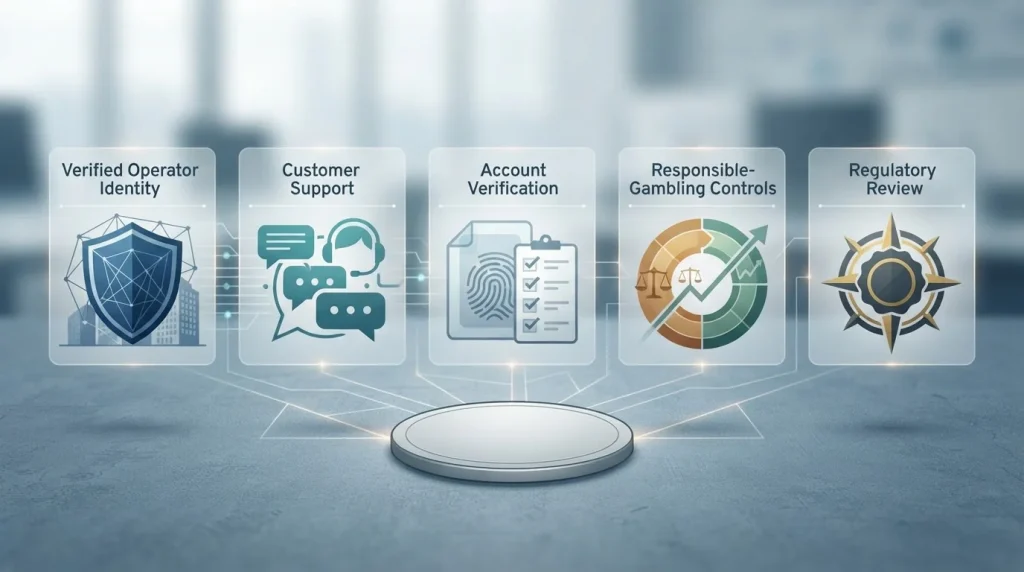
Spins of Glory has several verifiable trust signals, including an identified operator, live chat, a published support email, KYC controls and a self-exclusion route. Those points are useful, but they do not amount to a guarantee of safety, fast payouts or favourable dispute outcomes. For an Australian reader, the regulatory position is especially important: Spins of Glory is provided by NovaForge Ltd, does not hold an Australian State or Territory interactive wagering licence, and has been the subject of an ACMA formal warning concerning prohibited and unlicensed regulated interactive gambling services.
The most useful way to judge the brand is to separate the relevant factors. Check who operates it, how support can be reached, what account verification can require, what responsible-gambling controls exist, how withdrawals are governed and which regulator actually has jurisdiction. An offshore licence or a working website should not be treated as a substitute for Australian licensing or local consumer protection.
Table of Contents
- Safety depends on several separate signals
- Support is visible and reachable
- KYC is a normal part of the account risk model
- Self-exclusion is available through support
- The Australian regulatory gap is material
- ACMA’s warning is stronger evidence than a third-party badge
- Withdrawals should be assessed separately from general trust
- How to use public complaints without overreading them
- Five checks before treating a casino as trustworthy
- What should not be inferred from website access
- How the evidence should shape the safety assessment
- Where to continue the review
- Is Spins of Glory Safe? Trust, Support and Player Protections
Safety depends on several separate signals
Casino reviews often compress trust into one rating, but the underlying questions are different. Operator identity is one question. Availability of support is another. Account verification, self-exclusion, withdrawal rules and licensing each answer something else. A brand can look strong on one of those dimensions and weak on another.
For Spins of Glory, the verified operator identity is NovaForge Ltd. That is more useful than dealing with an anonymous brand because it gives the service a named corporate counterparty. The same fact is also relevant because ACMA’s published enforcement material names NovaForge Ltd in connection with Spins of Glory.
The presence of a named operator still should not be overstated. It does not guarantee solvency, payout speed, fairness or the outcome of a complaint. It simply removes one layer of uncertainty and gives the reader a concrete entity to compare against regulator records and terms.
Support is visible and reachable
Two support routes are verified for Spins of Glory: live chat and the published email address [email protected]. That gives users both an immediate channel and a written channel that can be useful for keeping a record of a request.
From a trust perspective, the important point is not merely that a chat icon exists. A useful support process should allow a player to explain a problem clearly, preserve reference details and obtain a response that can be compared with the site’s own rules. For payment or verification issues, a written summary of dates, requested documents and promised next steps is more valuable than repeatedly opening new conversations without a record.
Support availability should also be separated from support quality. The available information confirms the channels, not a universal response time or a guarantee that every case will be resolved quickly. Public complaint records show why that distinction matters, and the dedicated Spins of Glory complaints examines those reports without treating them as operator-wide proof.
KYC is a normal part of the account risk model
Spins of Glory’s current terms support the fact that identity and source-of-funds checks can be required. That matters because a withdrawal problem can sometimes be an account-verification problem rather than a payment-rail problem.
KYC is not, by itself, a negative trust signal. Identity checks are common in gambling and financial workflows. The useful question is whether the player understands that verification may occur, whether requests are made through legitimate channels, and whether the information being requested matches the operator’s stated process.
A player should avoid sending identity material to addresses or people that cannot be tied to the official service. It is also sensible to keep copies of what was submitted and when. KYC and verification details are covered separately; here, KYC is only one component of the wider trust assessment.
Self-exclusion is available through support
The current Spins of Glory terms state that self-exclusion can be requested through support. That is an important responsible-gambling control because it gives a user a route to request that access to gambling be restricted.
The existence of self-exclusion should be judged as a specific player-protection feature, not as proof that every other protection is equivalent to those available through an Australian-licensed wagering operator. Local regulatory frameworks can impose their own requirements and complaint pathways, and an offshore casino should not be assumed to participate in them.
If gambling is no longer recreational, the safest action is not to look for a better bonus or a different withdrawal method. It is to stop play and use available blocking, exclusion and support tools. That decision sits outside any question of whether a casino has attractive games or promotions.
The Australian regulatory gap is material
For Australian readers, the strongest limitation in the trust picture is regulatory rather than cosmetic. Spins of Glory does not hold an Australian State or Territory interactive wagering licence. ACMA has also published a formal warning to NovaForge Ltd concerning Spins of Glory and has described the service as prohibited and unlicensed regulated interactive gambling in the Australian context.
This matters because an offshore licence is not the same thing as local regulatory coverage. A player should not assume access to Australian licensed-wagering safeguards, regulator-supervised dispute processes or local approval merely because the casino is accessible, accepts AUD or has account controls.
The dedicated Spins of Glory license explains that distinction in detail. The key point for safety evaluation is narrower: regulatory jurisdiction determines which formal protections can reasonably be expected, and Spins of Glory is not an Australian-licensed interactive wagering service.
ACMA’s warning is stronger evidence than a third-party badge
Official regulator records carry more weight than third-party ratings. A star rating or affiliate score is a third-party opinion, while an ACMA enforcement record is an official regulator finding; the two should not be treated as equivalent.
ACMA’s formal warning identifies NovaForge Ltd and Spins of Glory directly. Its broader reporting also records the service in the regulator’s interactive-gambling enforcement activity. For an Australian reader, that should carry more weight than generic claims that a casino is “trusted” or “safe” because it has been operating for a period of time.
This does not require exaggeration. The warning does not prove that every withdrawal fails or that every player suffers harm. It establishes a concrete Australian regulatory concern about the provider-side offering of the service. That is enough to make it a central part of an trust assessment.
Withdrawals should be assessed separately from general trust
Payment performance is one of the most important practical trust checks, but it needs its own evidence. Spins of Glory publishes withdrawal ceilings that vary by VIP level, and its terms allow verification checks. Those facts explain some of the framework around cashing out, but they do not guarantee a particular processing experience for an individual user.
A player evaluating a withdrawal should keep three questions separate: whether the amount fits the published account limits, whether any verification request is outstanding, and whether the withdrawal has moved within the timeframe actually stated for that transaction. Mixing those questions makes it harder to identify the cause of a delay.
The Spins of Glory withdrawal covers the published limits and verification relationship in detail. This safety page does not repeat every limit because trust should not be reduced to one maximum-cashout number.
How to use public complaints without overreading them
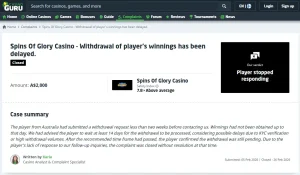
Complaint platforms can reveal recurring themes that deserve attention, especially when several cases concern withdrawals or verification. They are useful as context because they show the kinds of problems real users chose to report publicly.
They are weaker than casino terms for proving a rule and weaker than regulator records for proving legal status. A complaint can be incomplete, one-sided, resolved later or closed because the complainant stopped responding. The correct use is therefore pattern recognition, not universal judgement.
When looking at complaints, record the amount, country, issue type, submission date and final status. A resolved case tells a different story from an unresolved one, while a case closed because a player stopped responding cannot be treated as proof that the operator either solved or caused the issue. This distinction is central to the dedicated complaints analysis.
Five checks before treating a casino as trustworthy
First, identify the operator and compare that name with regulator records. Spins of Glory passes the identity check in the sense that NovaForge Ltd is a verified named provider, but the same search also reveals the ACMA warning.
Second, verify support routes before depositing. Live chat and [email protected] are established channels. Save written confirmations when a request concerns money or identity documents.
Third, understand KYC before a withdrawal is urgent. Identity and source-of-funds checks can be required, so a player should expect that account verification may become part of the process.
Fourth, check which responsible-gambling controls are actually available. Self-exclusion can be requested through support, which is a concrete control rather than a generic responsible-gambling statement.
Fifth, separate offshore licensing from Australian licensing. The most important local fact is that Spins of Glory does not hold an Australian State or Territory interactive wagering licence and has been subject to ACMA enforcement.
What should not be inferred from website access
A website loading in Australia is not regulatory approval. A visible AUD option is not regulatory approval. A functioning registration flow is not regulatory approval. Those are product-access observations, not licence records.
The reverse is also important. A casino being offshore does not automatically tell a reader whether a particular support request will be answered or whether a specific withdrawal will succeed. Those outcomes depend on separate operational facts and individual circumstances.
This separation prevents both overconfidence and overstatement. The regulatory evidence is serious and directly relevant, while operational features such as support and KYC should still be described on their own evidence.
How the evidence should shape the safety assessment
The evidence supports a mixed assessment rather than a single reassuring badge. On the positive side, Spins of Glory has a verified operator identity, live chat, a published support email, KYC controls and a support-based self-exclusion route. These are concrete, observable trust and account-management signals.
On the risk side, Australian readers do not have a verified Australian State or Territory interactive wagering licence behind the service, and ACMA has taken formal enforcement action against NovaForge Ltd concerning Spins of Glory. That regulatory difference should be treated as material when comparing the brand with locally licensed wagering services.
None of these facts guarantees a payout, fairness, security or dispute result. The most defensible assessment is that Spins of Glory provides identifiable support and account controls, but Australian users should understand that the service sits outside the Australian licensed-wagering framework and should evaluate withdrawals and complaints separately.
Where to continue the review
For a broader product view, the Spins of Glory Australia review connects the safety picture with games, bonuses, payments, registration and mobile access. For regulatory detail, use the licence page. For cashout mechanics, use the withdrawals page. For reputation evidence, use the complaints page.
That structure is deliberate. Trust is not one fact and should not be presented as one. A reader makes a better decision by checking regulation, account controls, payment terms and complaint patterns independently, then deciding how much weight each deserves.