Spins of Glory Withdrawals: Limits, Timing and Verification
 Available in US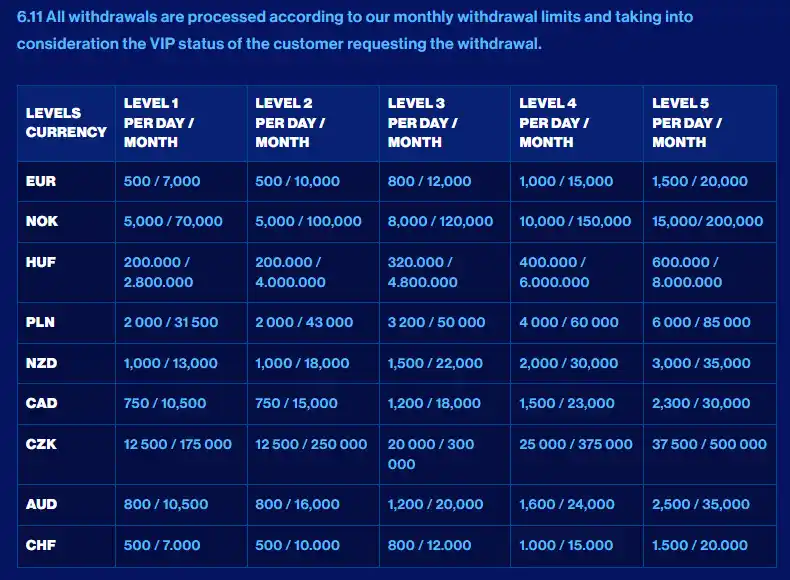
Spins of Glory publishes AUD withdrawal ceilings that vary by VIP level. The verified table starts at A$800 per day and A$10,500 per month for Level 1 and rises to A$2,500 per day and A$35,000 per month for Level 5. Those figures are more useful than a generic “fast payout” claim because they show that cash-out capacity can depend on account status. Identity and source-of-funds checks may also be required, so verification can affect the practical withdrawal path.
The sensible way to assess a withdrawal is to separate three things: the published rules, the account’s current verification status and the individual transaction. Do not treat a complaint anecdote as proof of a universal payout outcome, and do not treat one successful cash-out as a guarantee for every future request. For the payment context before this stage, see the Spins of Glory payment methods.
Table of Contents
- The published AUD limits are tiered
- Daily and monthly ceilings answer different questions
- KYC can become part of the withdrawal path
- Check the withdrawal route before building a large balance
- Do not confuse a ceiling with a guaranteed payout amount
- Complaints belong in a separate evidence category
- What a withdrawal request should be checked against
- Planning a larger cash-out with tiered limits
- Verification readiness is a controllable part of the process
- How to read a pending withdrawal
- Australian users should separate operator terms from local payment habits
- Red flags in withdrawal advice
- What to carry into a withdrawal request
- Spins of Glory Payment Methods in Australia
The published AUD limits are tiered
The fact that matters most for larger withdrawals is not a single universal ceiling. Spins of Glory’s published AUD limits are tied to VIP level. Level 1 is listed at A$800 per day and A$10,500 per month, while Level 5 is listed at A$2,500 per day and A$35,000 per month. The intermediate levels sit between those endpoints.
This changes how the limit should be interpreted. A user should not see the highest published figure and assume it applies to a new account. The relevant number is the current account level at the time of the withdrawal request. Equally, a lower-level ceiling does not mean the account can never have a higher one; the published structure makes the limit tier-dependent.
Because withdrawal limits are freshness-sensitive financial terms, the current official rules should be checked again when a large cash-out is planned. The values above are included because the current official Terms confirm these details.
Daily and monthly ceilings answer different questions
A daily ceiling controls how much can be requested or processed within the operator’s daily framework, while a monthly ceiling controls the larger cumulative amount. Looking at only one can give an incomplete picture. For example, a player considering a sizeable balance needs to understand both how much can move in a day and how long the monthly ceiling could make a full cash-out take.
The Level 1 pair of A$800 daily and A$10,500 monthly therefore describes a different practical situation from the Level 5 pair of A$2,500 daily and A$35,000 monthly. The difference is not merely cosmetic VIP branding; it can change how a larger withdrawal is staged.
That is also why “payout speed” should not be reduced to one headline number. A transaction can be subject to a published ceiling even before any bank or payment-provider processing is considered.
KYC can become part of the withdrawal path
Spins of Glory’s verified terms allow identity and source-of-funds checks. That means a withdrawal decision should include account verification readiness rather than assuming payment is purely a cashier action. If the account is asked for verification, the relevant issue is whether the requested information can be provided accurately and whether the account details match the payment activity.
That general verification fact does not imply a fixed document list or guaranteed completion time. Exact KYC requirements can vary by case. The dedicated Spins of Glory KYC explains the verification stage without implying that every account receives the same request.
A practical precaution is to keep registration information accurate and use payment methods that belong to the account holder. When a withdrawal review asks questions about identity or funding source, inconsistent account information can make an already sensitive process harder to resolve.
Check the withdrawal route before building a large balance
The best time to understand withdrawal mechanics is before a large deposit, not after a balance has accumulated. Open the withdrawal section where possible and inspect which methods are currently shown. The Spins of Glory deposit methods recommends this same full-cycle check because a convenient funding method is not automatically the simplest cash-out route.
Method availability can change, so a static list is less reliable than the live account interface. The current cashier can also reveal whether a withdrawal route is unavailable until verification is completed or whether additional account steps appear before a request can be submitted.
This approach makes the payment decision more symmetrical. Deposits answer “how does money enter?” Withdrawals answer “how can money leave, under what account conditions and within what published ceilings?” Both should be understood before the payment setup is treated as convenient.
Do not confuse a ceiling with a guaranteed payout amount
A published withdrawal limit is a maximum framework, not a promise that every request up to that amount will automatically be approved. Account verification, payment eligibility, bonus conditions and other applicable account rules can still matter. The table tells users the size boundary associated with a VIP level; it does not erase the rest of the withdrawal process.
The reverse is also important. A ceiling is not evidence that withdrawals below it will be delayed or disputed. It is simply a published constraint to use when planning the size and sequence of requests. Treating the number neutrally avoids turning terms information into either a guarantee or an alarm signal.
For users with a modest balance, the monthly ceiling may never become practically relevant. For a larger balance, the tier structure is more consequential because it can determine how many separate requests are needed over time.
Complaints belong in a separate evidence category
Public complaint material can be useful as reputation context, but anecdotes should not be treated as if they were operator terms or universal outcomes. A single complaint can describe a real person’s experience without establishing what will happen to every account. Conversely, the absence of a complaint cannot prove that every future withdrawal will be trouble-free.
Withdrawal rules and reputation should therefore be kept separate. The dedicated Spins of Glory complaints is the appropriate place to evaluate complaint evidence on its own merits. Here, the focus is on the verified withdrawal framework and the practical checks an Australian user can make.
That separation prevents a common review error: mixing a terms table, a support anecdote and a user story into one vague payout rating. Different evidence types answer different questions and should remain visibly distinct.
What a withdrawal request should be checked against
Start with the current VIP level and the corresponding AUD limits. Then confirm that the account information is accurate and that there is no outstanding verification request. Next, inspect the actual withdrawal method offered to the account rather than assuming the original deposit route will always be available.
If a bonus was used, make sure the promotional conditions have been satisfied before treating the balance as immediately withdrawable. The bonus guide covers those rules separately. This avoids confusing a bonus restriction with a payment-method problem.
Finally, keep the transaction reference and any messages shown by the cashier. If a request needs follow-up, specific account-level evidence is more useful than a general claim about how long withdrawals “usually” take.
Planning a larger cash-out with tiered limits
For a balance that approaches or exceeds the relevant daily ceiling, the first planning question is how the amount fits within the account’s current tier. At Level 1, the A$800 daily limit means a multi-thousand-dollar balance cannot be treated as a one-request event. At Level 5, the A$2,500 daily ceiling provides more room, but the monthly A$35,000 cap still matters for very large balances.
The monthly figures also give context to the daily numbers. A user should not multiply a daily ceiling by the number of days in a month and assume that total is available, because the separate monthly cap can become the binding constraint. Reading both columns avoids that mistake.
This is practical planning, not a prediction of processing speed. The published limits describe allowable capacity within the operator’s framework. The actual path of an individual request can still depend on account checks and the payment route used.
Verification readiness is a controllable part of the process
Users cannot control every operational step, but they can reduce avoidable friction by keeping account details consistent. A name, date of birth or address that does not match the information later used for verification can create questions that would not exist with accurate records. The same applies to using a payment method that does not clearly belong to the account holder.
Because source-of-funds checks may be required, it is also useful to retain ordinary transaction records rather than deleting or losing them immediately after a deposit. That does not mean every withdrawal will trigger a source-of-funds review. It simply makes the account easier to explain if the operator asks for verification.
The important distinction is between being prepared and assuming a fixed checklist. Verification is a conditional process. No single document set should be assumed to cover every account.
How to read a pending withdrawal
A pending request is a status, not an explanation. It can exist while the operator performs account checks, while a payment instruction is being prepared or while another condition still needs attention. Without account-specific information, it is not useful to assign a universal cause.
If a request remains pending, first review the account and cashier for any verification notice or action request. Then check whether the amount fits the current VIP ceiling and whether the selected route remains available. Keep communication focused on the specific request rather than opening multiple duplicate withdrawal attempts that could make the record harder to follow.
If the issue becomes a dispute or complaint, move the evaluation into the evidence framework used on the dedicated complaints page. That keeps transaction troubleshooting separate from broader reputation inferences.
Australian users should separate operator terms from local payment habits
Australian consumers are accustomed to fast electronic payments in everyday life, but that experience does not create a guaranteed casino withdrawal time. Casino withdrawals can involve operator review, account verification and a payment route that differs from an ordinary domestic transfer.
This is why the payment overview separates national context from brand facts. AUD support and the published VIP-based limits are verified Spins of Glory facts. Broader Australian expectations about cards, banking and mobile payments help explain user preferences, but they should not be used to promise how a particular withdrawal will behave.
For the same reason, no Australian payment brand is named here as a guaranteed withdrawal option unless the current account interface establishes it. The live cashier is the best current reference for method availability.
Red flags in withdrawal advice
Be cautious with reviews that promise a guaranteed payout time, present the highest VIP limit as if it applies to every account or publish an exact document checklist without current primary evidence. Those shortcuts make a complex process sound simpler than the underlying terms support.
Also be cautious with the opposite extreme: a review that turns a handful of public complaints into a claim that all withdrawals fail. Reputation evidence is relevant, but it needs its own sourcing and should not overwrite the published rules. A useful review distinguishes operator terms, account-level conditions and anecdotal reports instead of blending them.
That distinction is especially important for a financial decision page. The goal is not to make the casino look safer or riskier than the evidence supports; it is to show what is known, what depends on the account and what needs a current cashier check.
What to carry into a withdrawal request
Spins of Glory’s verified AUD withdrawal framework is tiered by VIP level, from A$800 per day and A$10,500 per month at Level 1 to A$2,500 per day and A$35,000 per month at Level 5. Identity and source-of-funds checks may also be required. Those are the core facts to carry into a cash-out decision.
Before requesting a withdrawal, confirm the current VIP level, review the live method options, make sure account information is accurate and respond to any verification request. Treat complaints as separate reputation evidence rather than as universal payout rules. For a broader view of the site and its Australian context, return to the Spins of Glory Australia review.