Spins of Glory Complaints and Withdrawal Feedback
 Available in US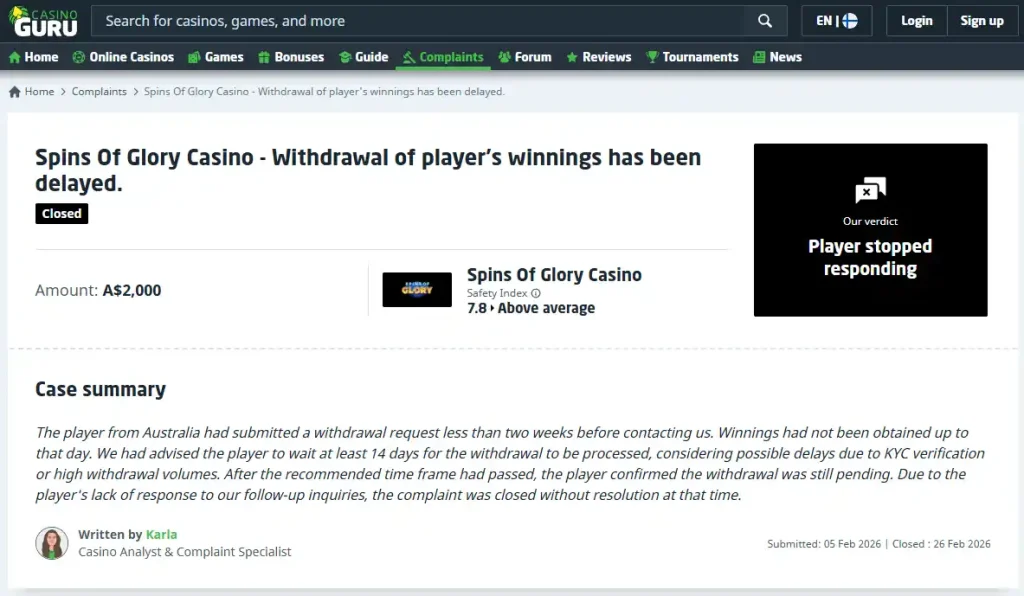
Public complaint records for Spins of Glory include several withdrawal-delay disputes. One Casino Guru case involved an Australian player and A$2,000; the complaint was eventually closed without resolution after the player stopped responding to follow-up requests. AskGamblers also lists multiple withdrawal-related complaints with mixed outcomes, including resolved cases and an unresolved case. These reports are relevant because they show the kinds of payment problems users have raised, but they do not prove that every Spins of Glory player will experience the same thing.
The right way to read complaints is to separate allegation, operator response, platform outcome and casino terms. A complaint can flag a pattern worth investigating, while the official rules remain the better source for published withdrawal limits and account-verification requirements. Complaint evidence is contextual, not a substitute for the terms.
Table of Contents
- The Australian A,000 complaint
- Other public complaints point to withdrawal friction
- Resolved does not mean the original complaint was false
- Official withdrawal rules remain the factual baseline
- How to analyse a withdrawal complaint properly
- What complaint sites can prove – and what they cannot
- Support records matter when a dispute develops
- Australian users should keep the regulatory context separate
- Warning signs that deserve closer attention
- How much weight should the complaints carry?
- The complaint record in context
- Recommend
The Australian A$2,000 complaint
A current Casino Guru complaint record describes an Australian player who reported a delayed A$2,000 withdrawal. The case was submitted on 5 February 2026 and closed on 26 February 2026. Casino Guru’s final status says the player stopped responding, so the platform closed the complaint without establishing a final resolution.
That outcome is important. It would be inaccurate to call the case resolved in the player’s favour, and equally inaccurate to treat it as proof that the casino permanently refused payment. The public record stops before either outcome can be verified.
The complaint is still useful as evidence that an Australian user reported a meaningful withdrawal delay and repeatedly contacted support. It therefore belongs in a reputation analysis, but only with the status attached.
Other public complaints point to withdrawal friction
AskGamblers currently displays several Spins of Glory complaints involving delayed or cancelled withdrawals. Some are marked resolved after later payment or case handling, while at least one listed withdrawal complaint remains unresolved. The platform also shows historical complaint statistics, but those aggregate figures can change as new cases are added and should not be treated as a permanent property of the casino.
The repeated topic is more informative than any single score: users have publicly raised questions about withdrawals, waiting periods and support responses. That repetition justifies checking cashout terms carefully before depositing.
It does not establish an operator-wide policy of withholding withdrawals. Complaint platforms publish individual disputes, often with incomplete evidence and different currencies, countries and account circumstances. Those limitations should remain visible when assessing the complaints.
Resolved does not mean the original complaint was false
When a complaint platform marks a case resolved, it usually means the dispute reached an outcome acceptable enough for the platform to close the case. It does not mean the initial delay never happened. Likewise, an unresolved case does not automatically prove intentional wrongdoing.
This distinction matters when comparing casinos. A pattern where complaints are eventually paid after intervention is different from a pattern where cases remain unanswered, but both still tell a reader something about operational friction.
For Spins of Glory, the public record is mixed rather than one-directional. There are withdrawal complaints that later reached resolved status and others that did not produce a clean resolution. That makes the evidence useful for caution, not for a universal assessment.
Official withdrawal rules remain the factual baseline
The casino’s current terms publish AUD withdrawal ceilings by VIP level. At Level 1 the verified ceilings are A$800 per day and A$10,500 per month, rising to A$2,500 per day and A$35,000 per month at Level 5. Those numbers describe the rule framework; they are not predictions of how quickly a particular withdrawal will be processed.
The same terms also support the fact that identity and source-of-funds checks can be required. That creates a practical reason to distinguish a limit issue from a verification issue and from a pure processing delay.
The Spins of Glory withdrawal explains those limits in full. They are useful here only for showing why a complaint should be compared with the account rules before drawing broad inferences.
How to analyse a withdrawal complaint properly
Start with the amount and currency. A complaint involving A$2,000 should be compared with the relevant AUD withdrawal ceiling and the player’s account level if that information is available. A complaint in another currency cannot simply be mapped onto the Australian limits without verified conversion and account context.
Next, look for verification status. If KYC or source-of-funds checks are outstanding, the dispute may involve compliance steps as well as payment processing. If the complaint says verification was complete, that changes the context but still does not prove the entire cause of a delay.
Then check the timeline. Record when the withdrawal was requested, when support was contacted and when the complaint platform closed the case. Avoid importing a processing-time promise from one complaint into another unless the official terms support the same value.
Finally, read the closure reason. “Resolved”, “unresolved” and “player stopped responding” are materially different outcomes and should never be collapsed into one complaint count.
What complaint sites can prove – and what they cannot
Complaint sites can prove that a complaint was published, what the complainant alleged, how the operator or platform responded publicly and how the case was classified. They can also show recurring themes across several disputes.
They cannot independently prove every private account event. The platform usually does not have complete access to casino back-office records, bank processing logs or all communications between the parties. That is why a complaint narrative remains an anecdotal record even when it is detailed.
Complaint status and basic facts should therefore be stated without making claims such as “Spins of Glory never pays” or “all complaints are solved”. Neither statement is supported by the available evidence.
Support records matter when a dispute develops
Spins of Glory has verified live chat and a published support email at [email protected]. A player dealing with a withdrawal issue can use those channels to create a dated record of questions and responses.
For a complaint, useful records include the withdrawal request date, amount, currency, transaction status, any verification request and the text of support replies. Saved records should avoid exposing passwords, full card details or unnecessary identity documents.
Keeping a clean record does not guarantee a particular result, but it makes it easier to explain the sequence of events if the matter later reaches a complaint platform. It also reduces the risk of relying on memory for dates and promises.
Australian users should keep the regulatory context separate
Complaint history and regulatory status are different evidence streams. The Spins of Glory license explains that Spins of Glory does not hold an Australian State or Territory interactive wagering licence and that ACMA has issued a formal warning to NovaForge Ltd concerning the service.
That regulatory fact should not be used to rewrite every complaint as proof of illegality or misconduct. At the same time, an Australian player should not assume that an offshore complaint process offers the same protection or escalation route as a locally licensed wagering service.
The broader Spins of Glory safety brings those strands together: operator identity, support, KYC, self-exclusion, withdrawals and Australian regulatory status.
Warning signs that deserve closer attention
A single slow withdrawal is not enough to establish a pattern, but repeated reports around the same process deserve scrutiny. The Spins of Glory complaint record contains enough withdrawal-focused cases that cashout handling is a reasonable area for extra checking.
More useful warning signs include a mismatch between published limits and what support says, changing explanations for the same delay, repeated requests for the same verification material, or a complaint that remains unresolved after the player has supplied the requested information. Those are process signals rather than assumptions about motive.
Readers should also be cautious with complaint summaries that omit status. A dramatic headline can remain visible even after a case is paid or closed for lack of response. The final case record is more informative than the headline alone.
How much weight should the complaints carry?
The public complaints justify caution around withdrawal expectations, but they should not carry all the weight in a casino evaluation. They are one layer alongside official terms, regulatory evidence, support accessibility and account controls.
The Australian A$2,000 case is especially relevant to Australian readers because it comes from an Australian complainant, yet its closure without resolution limits what can be concluded. The AskGamblers records add evidence that withdrawal friction has appeared in other jurisdictions too, but their mixed statuses argue against a simplistic assessment.
A reasonable approach is to treat withdrawal handling as an area to monitor closely: understand the published limits, complete verification promptly when legitimately requested, keep records and do not assume that a complaint outcome for another player predicts your own.
The complaint record in context
Spins of Glory’s complaint footprint contains real withdrawal disputes, including the Australian A$2,000 case and several cases on AskGamblers. Some were resolved; some were not cleanly resolved. That is enough to make complaints relevant to the review, but not enough to claim a universal payout problem.
The strongest approach is to keep the evidence types separate. Use official terms for withdrawal ceilings and KYC requirements, complaint sites for anecdotal experience patterns, and ACMA for the Australian regulatory position. Each source answers a different question.
For the broader product picture, return to the Spins of Glory Australia review. For payment mechanics, use the withdrawals guide. For the combined trust assessment, use the safety page. That keeps complaint evidence in proportion rather than turning it into either marketing reassurance or an unsupported accusation.
Recommend

Spins of Glory Bonuses for Australian Players
The Spins of Glory welcome package for Australian players is advertised at up to 250%...

Spins of Glory Licence and Australian Regulatory Status
Spins of Glory operates under an Anjouan gambling licence, but it does not hold an...

Spins of Glory Payment Methods in Australia
Spins of Glory supports AUD, so Australian users can evaluate the cashier without first translating...

Spins of Glory Games and Pokies Guide
Spins of Glory presents a very large casino catalogue, with more than 10,000 games in...

Spins of Glory Mobile Casino and App Experience
Spins of Glory does not require a dedicated native app. Mobile access is browser-based, so...

Is Spins of Glory Safe? Trust, Support and Player Protections
Spins of Glory has several verifiable trust signals, including an identified operator, live chat, a...

How to Register at Spins of Glory
Opening a Spins of Glory account involves more than choosing login details. The current terms...