Spins of Glory KYC and Account Verification
 Available in US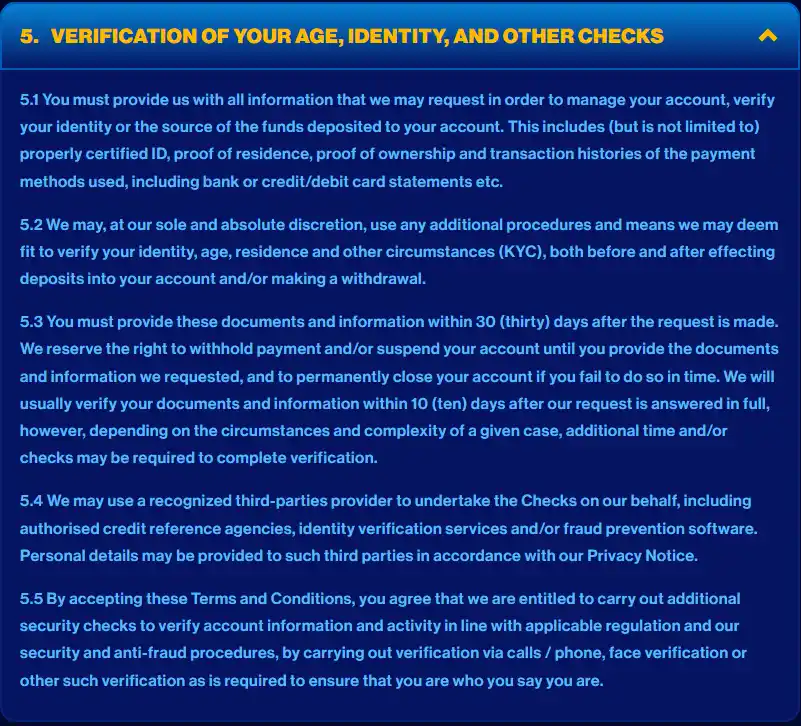
Spins of Glory can require identity, residence and source-of-funds checks before or after deposits and in connection with withdrawals. Its current General Terms say requested evidence can include properly certified ID, proof of residence, and proof of ownership or transaction history for the payment methods used. The same Terms say documents and information should normally be verified within 10 days after a request has been answered in full, while more complex cases can take longer.
For an Australian reader, the most useful way to approach KYC is as withdrawal preparation rather than a last-minute obstacle. The practical goal is to keep the account name, address and payment ownership consistent from registration onward, respond completely if a check is triggered, and avoid assuming that a withdrawal timetable starts running independently of verification.
Table of Contents
- What Spins of Glory can ask to verify
- When verification can happen
- The 30-day response window and the 10-day review statement
- How KYC affects withdrawals
- Payment ownership is part of the identity trail
- Source-of-funds checks are broader than basic ID
- What a complete response should look like
- Privacy and document handling deserve attention
- Australian regulation is separate from KYC
- A practical KYC readiness checklist
- What the KYC page ultimately tells an Australian reader
- Recommend
What Spins of Glory can ask to verify
The current Terms give the operator broad authority to request information needed to manage the account, verify identity and establish the source of deposited funds. The examples listed are specific enough to be useful without inventing a fixed checklist: properly certified identity documents, proof of residence, and records showing ownership or transaction history for the payment methods used. These categories connect the account holder, the address on file and the source or movement of money through the account.
That wording matters because KYC is not described as a single document upload that permanently completes every possible review. Spins of Glory says additional procedures can be used to verify identity, age, residence and other circumstances. The Terms also mention extra security checks such as calls or face verification where required. The practical implication is that an account can pass one check and still face a later request if activity, payment ownership or source-of-funds questions create a new reason to review it.
The safest reading is therefore category-based rather than speculative. A reader can prepare for proof of identity, residence and payment ownership because those categories are explicitly stated. A reader should not assume that a particular passport page, utility-bill age limit, selfie format or bank-statement period will always be required unless the live request states it.
When verification can happen
Spins of Glory states that KYC can occur both before and after deposits and in connection with a withdrawal. That means verification is not confined to the cashout stage. It can be part of account administration at several points, including after financial activity has already started.
For practical planning, this is important because a user who treats KYC as something that happens only after clicking withdraw may create avoidable friction. The stronger approach is to make the account verifiable from the start: register in the correct personal name, keep the address current and use payment methods that belong to the account holder.
The dedicated Spins of Glory registration covers the account-creation side in more detail. The focus here is what happens once the operator requests verification evidence.
The 30-day response window and the 10-day review statement
The current Terms say requested documents and information must be provided within 30 days after the request is made. They also say verification is usually completed within 10 days after the operator’s request has been answered in full. These are different clocks: one concerns the customer’s response window, while the other concerns the operator’s usual review period once the response is complete.
Sending one document does not necessarily start the 10-day period if the request asked for several items and the response remains incomplete. The wording ties the usual verification period to a request being answered in full. If the operator asks for clarification or additional checks because of the circumstances or complexity of the case, the Terms explicitly allow the review to take longer.
For that reason, exact timing should be treated as freshness-sensitive. The 10-day statement is useful because it is currently in the official Terms, but it is not a guaranteed completion deadline.
How KYC affects withdrawals
The withdrawal section of the Terms gives the operator the right to delay processing while it checks identity, account balance, source of funds and compliance with the Terms. It also says payments can be postponed until required verification procedures and checks are successfully completed.
This is why the most useful withdrawal preparation happens before the request. If identity details, residence information and payment ownership are already consistent, the evidence trail is easier to understand.
The Spins of Glory withdrawal covers limits, timing and the withdrawal process separately. The key point here is narrower: verification can interrupt or extend that process, and no payout schedule should be read as bypassing KYC.
Payment ownership is part of the identity trail
The Terms state that the payment method used to top up the account should belong to the account holder. They also allow proof of payment-method ownership and transaction history to be requested during KYC.
A practical error is to think of payment choice as purely a cashier convenience. From a verification perspective, the payment instrument can become evidence. A card, account or wallet that does not clearly belong to the registered user can create a question that would not exist if the identity trail were consistent.
This does not mean every available method will trigger the same documents. It means the ownership relationship matters.
Source-of-funds checks are broader than basic ID
Identity checks answer who controls the account. Source-of-funds checks address where money used on the account comes from. Spins of Glory explicitly includes source of funds among the information it can request.
The Terms do not provide a universal public checklist for every source-of-funds case. That is a reason not to invent one. Depending on the actual request, evidence can relate to bank or card statements, transaction history or other information capable of showing ownership and movement of funds.
For an Australian user, the decision-useful lesson is to keep financial activity explainable and tied to the account holder.
What a complete response should look like
A strong response to a KYC request is complete, legible and internally consistent. The name should match the account, the address evidence should correspond with the current account details, and any requested payment evidence should clearly relate to the payment method actually used.
It is also useful to answer the actual request rather than sending an unrelated bundle of documents. If the operator asks for identity, residence and payment ownership, each category should be addressed.
Because the Terms permit additional checks, completion should be understood as a process state rather than a one-time badge.
Privacy and document handling deserve attention
KYC necessarily involves sensitive personal and financial information. The Terms say third-party providers can be used for checks and refer users to the site’s Privacy Notice for the handling of personal details.
A cautious user should use only the operator’s authenticated account or support channels for requested evidence and should avoid sending documents to addresses or forms reached through unsolicited messages.
The core point is simple: KYC evidence is high-value personal data. Verification readiness should include checking that the request and upload destination are genuine.
Australian regulation is separate from KYC
KYC compliance at the casino should not be confused with Australian regulatory approval. ACMA states that the Interactive Gambling Act 2001 makes it illegal for providers to offer online casino services to people in Australia. ACMA has also published enforcement action involving NovaForge Ltd and Spins of Glory.
Passing identity verification does not change that provider-side legal context, and the existence of a KYC process does not establish local regulatory approval. The Spins of Glory licence and Australian regulatory status guide explains the distinction.
This distinction matters in practice. KYC tells a user what evidence the operator can request. Regulation tells the user which legal framework governs the provider’s ability to offer the service in Australia.
A practical KYC readiness checklist
Before depositing or requesting a withdrawal, confirm that the account is in the correct personal name, the address is current and the payment method belongs to the account holder. Keep suitable identity and residence evidence accessible, and retain records that can show payment ownership or transaction history if requested.
If a verification request arrives, read it carefully, answer every requested category, use the official upload or support route and keep copies of what was submitted. Note the date on which the request was answered in full because the current Terms tie their usual 10-day verification statement to that point.
Finally, treat any later request for extra checks as part of the same process rather than evidence that the first response was ignored.
What the KYC page ultimately tells an Australian reader
The verified position is straightforward: Spins of Glory can request identity, residence, payment-ownership and source-of-funds evidence, and its current Terms say verification is usually completed within 10 days after a complete response, with longer reviews possible when additional checks are needed.
The practical consequence is that withdrawal readiness begins at registration. Accurate account data, payment methods owned by the account holder and a complete response to any later request reduce avoidable friction.
For a broader assessment of operator safeguards, account controls and regulatory context, see the Spins of Glory safety. KYC is one part of that picture, not a substitute for licensing, legal status or independent consumer protection.
For broader context, see Spins of Glory Australia review.
Recommend

Spins of Glory Bonuses for Australian Players
The Spins of Glory welcome package for Australian players is advertised at up to 250%...

Spins of Glory Licence and Australian Regulatory Status
Spins of Glory operates under an Anjouan gambling licence, but it does not hold an...

Spins of Glory Payment Methods in Australia
Spins of Glory supports AUD, so Australian users can evaluate the cashier without first translating...

Spins of Glory Games and Pokies Guide
Spins of Glory presents a very large casino catalogue, with more than 10,000 games in...

Spins of Glory Mobile Casino and App Experience
Spins of Glory does not require a dedicated native app. Mobile access is browser-based, so...

Is Spins of Glory Safe? Trust, Support and Player Protections
Spins of Glory has several verifiable trust signals, including an identified operator, live chat, a...
How to Register at Spins of Glory
Opening a Spins of Glory account involves more than choosing login details. The current terms...